 Eno
EnoTraditional Japanese Games: The Ultimate Guide to Heritage & Classic Play
From Kendama and Karuta to Hanetsuki and Sugoroku - the ultimate guide to 10 iconic traditional Japanese games, their history, rules, and cultural significance.
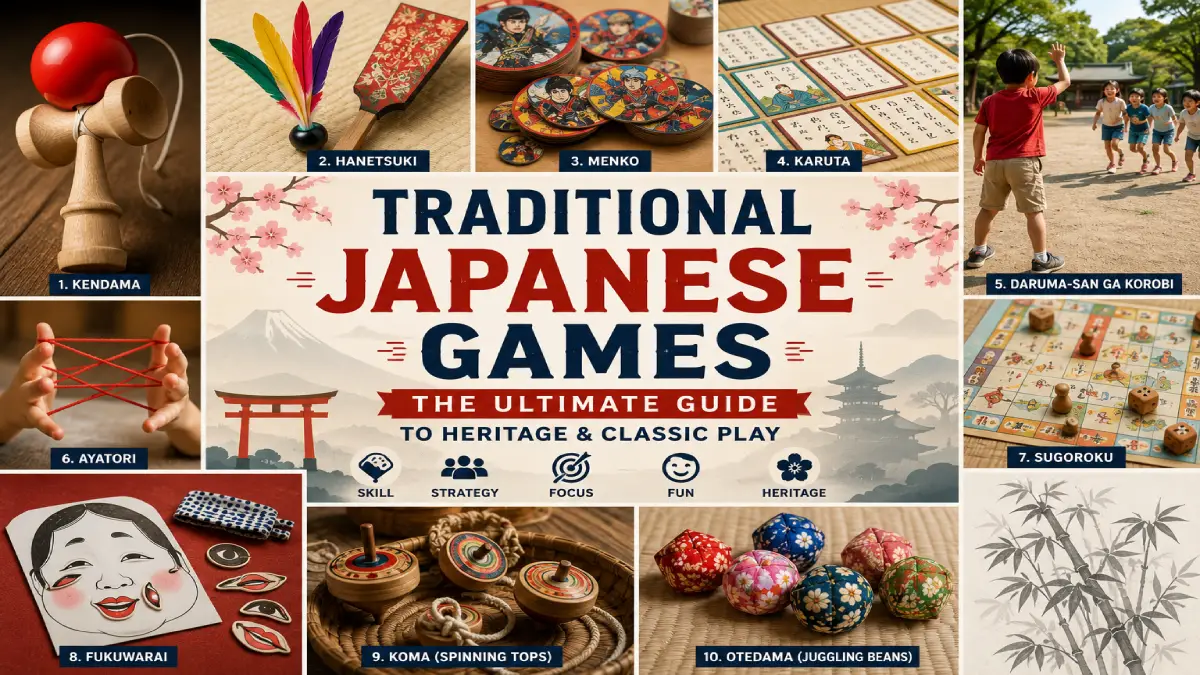
Long before video games, anime, and modern digital entertainment defined Japanese culture, traditional games (Dentō-teki na Asobi) were an essential part of daily life. Rooted in centuries of history-from the Edo period to traditional festivals-these games were designed with simple, natural materials like wood, paper, bamboo, and woven cords. Beyond entertainment, classic Japanese traditional games were crafted to teach dexterity, spatial focus, tactical patience, strategic thinking, and social harmony. In this comprehensive guide, we explore the rich history, mechanics, player requirements, and cultural significance of the most iconic traditional games from Japan.
The Heritage of Japanese Outdoor & Indoor Play
Japanese traditional games hold a special place in the country's heritage, especially during Oshōgatsu (New Year celebrations) and seasonal street festivals (Matsuri). Whether played on tatami mats inside traditional homes or out in temple courtyards, these games reflect the core values of Japanese craftsmanship and mindfulness.
Top Traditional Japanese Games
1. Kendama (Bicycle of the Hands)
Kendama is arguably Japan's most famous traditional wooden skill toy. It consists of a handle (Ken), a pair of cups (Sarado), and a ball (Tama) connected by a string. The player flips and catches the ball on different cups or spears it with the point of the stick.
- Category: Skill & Precision.
- Player Count: 1 player (or competitive turn-based).
- Equipment: Wooden Kendama setup.
2. Hanetsuki (Japanese Shuttlecock)
Played traditionally by girls during New Year celebrations, Hanetsuki resembles badminton without a net. Players use decorative rectangular wooden paddles (Hagoita) to hit a bright shuttlecock (Hane) made of a soapberry seed with colorful feathers attached.
- Category: Outdoor & Festival Game.
- Player Count: 2 players.
- Equipment: Hagoita paddle & Hane shuttlecock.
3. Menko (Traditional Card Slapping Game)
Menko is an explosive action card game dating back to the Edo period. Players place target thick cardboard or ceramic cards on a hard surface and slam their own heavy Menko card onto the floor to create air pressure and flip the opponent's card over.
- Category: Street & Pavement Game.
- Player Count: 2 or more players.
- Equipment: Thick Menko cards.
4. Karuta (Poetry & Picture Cards)
Karuta is a fast-paced card-matching game played during New Year holidays. A reader recites lines from classic poetry or proverbs (Ogura Hyakunin Isshu), while players race against each other to physically grab the matching card from the floor.
- Category: Strategy & Reaction.
- Player Count: 2 to 6 players.
- Equipment: Karuta card deck.
5. Daruma-san ga Korobi (The Daruma Fell)
This is the Japanese traditional equivalent of "Red Light, Green Light." One player acts as the "Daruma" standing at a wall facing away. As the Daruma recites "Da-ru-ma-sa-n-ga-ko-ro-bi-da" (The Daruma fell down), others run closer. When the Daruma turns around, everyone must freeze immediately.
- Category: Outdoor Reaction Game.
- Player Count: 4 to 15+ players.
- Equipment: None required.
6. Ayatori (Japanese Cat's Cradle)
Ayatori is a traditional geometric string game using a single loop of woven string. By wrapping the string around their fingers and pulling loops, players create intricate shapes like broomsticks, butterflies, climbing ladders, or mountain peaks.
- Category: Indoor Dexterity.
- Player Count: 1 or 2 players.
- Equipment: Loop of string.
7. Sugoroku (Traditional Board Game)
Sugoroku is a traditional Japanese board game similar to Snakes and Ladders. Players roll dice to move their markers along a illustrated paper path featuring journey routes across ancient Japan or story milestones.
- Category: Tabletop Board Game.
- Player Count: 2 to 6 players.
- Equipment: Sugoroku mat, dice, markers.
8. Fukuwarai (Lucky Laugh / Blindfolded Face Game)
A classic New Year game where a blindfolded player attempts to place cutouts of facial features (eyes, nose, mouth, eyebrows) onto a blank paper face outline of Okame (a smiling Japanese woman). The resulting funny expressions bring laughter and good luck for the new year.
- Category: Festive Indoor Party Game.
- Player Count: 2 to 8 players.
- Equipment: Paper face outlines & blindfold.
9. Koma (Spinning Tops)
Traditional Japanese wooden tops (Koma) are wound with a cotton cord and hurled onto a flat surface or a woven bowl (Beigoma arena). Players compete to see whose top spins the longest or knocks other tops out of the ring.
- Category: Outdoor Skill Game.
- Player Count: 2 or more players.
- Equipment: Wooden top & string.
10. Otedama (Japanese Juggling Beans)
Otedama is a rhythmic hand game usually played by children using small beanbags (Otedama) filled with azuki beans or rice. Players toss, juggle, and pick up bags from the floor in rhythm with traditional Japanese folk songs.
- Category: Indoor Rhythm & Coordination.
- Player Count: 1 to 4 players.
- Equipment: Small fabric beanbags.
Comparison Table of Traditional Japanese Games
| Game Name | Category | Primary Skill | Environment | Main Equipment |
|---|---|---|---|---|
| Kendama | Precision Skill | Hand-Eye Coordination | Indoor / Outdoor | Wooden Kendama |
| Hanetsuki | Outdoor Sport | Balance & Volleying | Outdoor Courtyard | Hagoita & Hane |
| Menko | Street Game | Force & Air Pressure | Hard Flat Surface | Heavy Cards |
| Karuta | Reflex & Memory | Rapid Memory & Touch | Indoor Tatami | Card Deck |
| Daruma-san ga Korobi | Outdoor Reaction | Stealth & Body Control | Outdoor Field | None |
| Ayatori | String Craft | Fine Finger Movement | Indoor | String Loop |
| Koma / Beigoma | Action Top | Launch Technique | Indoor / Outdoor | Top & Cord |
Frequently Asked Questions (FAQs)
What makes traditional Japanese games unique?
Traditional Japanese games emphasize physical craftsmanship, natural materials, balance, and communal harmony. Many of them are tied to seasonal festivals and New Year customs.
Which Japanese traditional game is played during New Year?
Hanetsuki, Karuta, Fukuwarai, and Sugoroku are all traditional New Year (Oshōgatsu) games played across Japan.
Is Kendama an officially recognized sport today?
Yes! Kendama has evolved from a traditional Japanese toy into a competitive worldwide sport with official trick rankings and world championships.
Conclusion
Traditional Japanese games are a beautiful bridge connecting ancient folklore, artistic craftsmanship, and active play. By preserving these heritage games, we keep the spirit of classic play alive for future generations.