 Eno
EnoTraditional Southeast Asian Games: The Ultimate Guide to Heritage & Street Play
From Sepak Takraw and Patintero to Sungka and Sipa - the ultimate guide to 10 iconic traditional Southeast Asian games, their history, rules, and cultural significance.
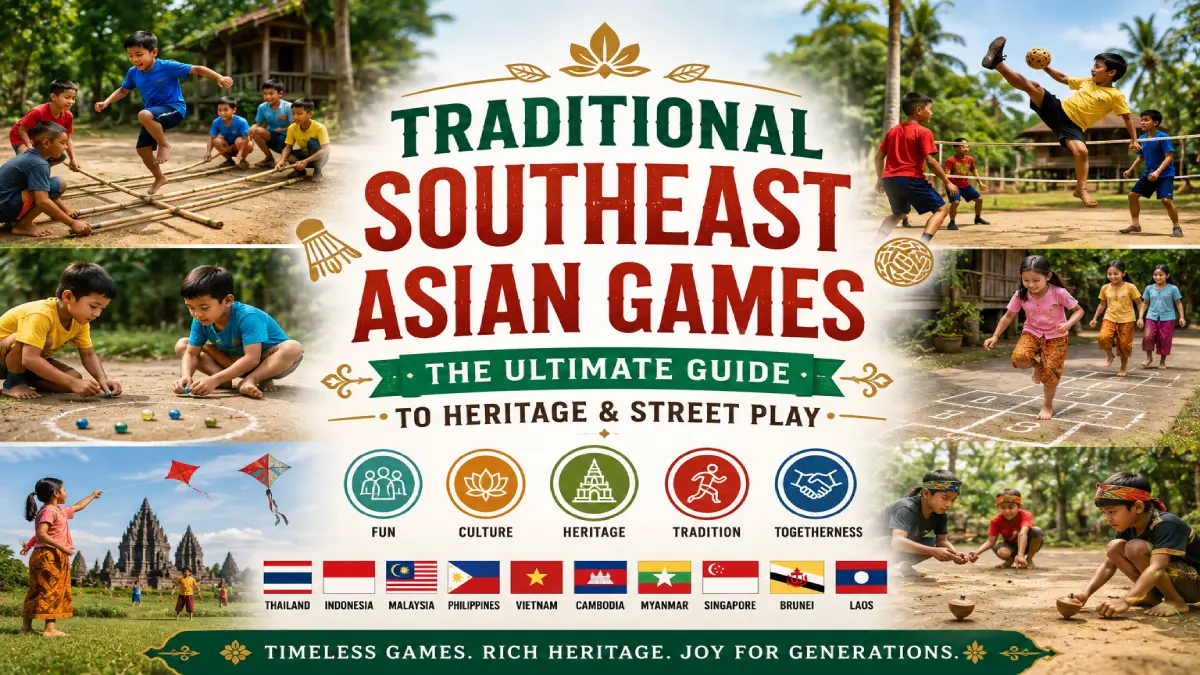
Across the vibrant cultures of Southeast Asia-including the Philippines, Indonesia, Vietnam, Malaysia, and Thailand-traditional games (Laro ng Lahi in the Philippines, Permainan Tradisional in Indonesia/Malaysia) have entertained generations of children. Built around community spirit, physical agility, and simple natural materials like bamboo, rubber bands, and coconut shells, these outdoor street games are an enduring part of the region's cultural identity. In this ultimate guide, we explore the history, gameplay, equipment, and social benefits of the most popular traditional games played across Southeast Asia.
The Heritage of Southeast Asian Street Play
In Southeast Asia, childhood play thrived in village courtyards (Barangay or Kampung), school grounds, and quiet residential lanes. Because expensive toys were rarely needed, children used creativity to turn everyday objects into competitive tools. These games emphasize team tactics, rapid reflexes, high jump capabilities, and sportsmanship.
Top Traditional Southeast Asian Games
1. Sepak Takraw (Kick Volleyball)
Sepak Takraw is Southeast Asia's ultimate traditional hybrid sport, combining elements of volleyball, soccer, and gymnastics. Players use their feet, knees, chest, and head to send a woven rattan ball over a net without letting it touch the ground or using their hands.
- Countries: Malaysia, Thailand, Philippines, Indonesia.
- Category: High-Agility Sport.
- Player Count: 3 per team (Trios).
- Equipment: Woven rattan or synthetic ball and a net.
2. Patintero (Block the Runner)
Patintero is a high-speed Filipino street game played on a grid drawn on asphalt. One team acts as runners trying to pass through the grid from one end to the other without getting tagged. The defending team stands along the grid lines, moving strictly left to right to block and tag the runners.
- Countries: Philippines (Patintero), Indonesia (Gobak Sodor).
- Category: Outdoor Team Strategy.
- Player Count: 4 to 10 players (2 teams).
- Equipment: Sidewalk chalk or water grid lines.
3. Sungka (Mancala Board Game)
Sungka is an ancient tabletop strategy game played using a wooden boat-shaped board featuring two rows of small pits and two large end stores (Head). Players move cowrie shells, stones, or marbles sequentially counter-clockwise to capture the most shells in their store.
- Countries: Philippines (Sungka), Indonesia (Congklak), Malaysia.
- Category: Indoor Strategy Board Game.
- Player Count: 2 players.
- Equipment: Wooden Sungka board and 98 cowrie shells or stones.
4. Luksong Baka (Jump over the Cow)
Luksong Baka is a popular physical hurdle game. One player acts as the "Baka" (cow) crouched down low on the ground. Other players take turns running and leaping over the back of the crouching player using only their hands for balance. As each round passes, the "Baka" gradually stands higher, making leaps increasingly challenging.
- Countries: Philippines.
- Category: Outdoor Jump & Vault.
- Player Count: 3 to 10 players.
- Equipment: None required.
5. Egrang (Bamboo Stilt Walking)
Egrang is a traditional Indonesian balance game played using tall bamboo poles fitted with foot rests at varying heights. Children race against each other while walking on stilts across grassy fields or packed soil, testing core balance and elevation control.
- Countries: Indonesia, Thailand, Philippines (Tiyakad).
- Category: Balance & Stilt Racing.
- Player Count: 2 or more players.
- Equipment: A pair of sturdy bamboo stilts.
6. Tumbang Preso (Knock Down the Can)
Tumbang Preso is a classic Filipino neighborhood favorite combining bowling and tag elements. A tin can is placed inside a small circle, guarded by a designated "It" (Taya). Other players throw rubber slippers (Pamato) from a line to knock over the can. Once the can is knocked over, players must retrieve their slippers and run back safely before "It" resets the can and tags them.
- Countries: Philippines.
- Category: Street Target & Tag.
- Player Count: 3 to 9 players.
- Equipment: 1 empty tin can & rubber slippers (Flip-flops).
7. Sepak Takraw Bulat (Circle Takraw)
Before the net version became standardized, Sepak Takraw was traditionally played in an open circle. Players stand in a wide ring passing the rattan ball continuously to one another using acrobatic kick tricks, keeping the ball airborne for as long as possible.
- Countries: Malaysia, Thailand, Myanmar (Chinlone).
- Category: Cooperative Rhythm & Skill.
- Player Count: 4 to 8 players.
- Equipment: Woven rattan ball.
8. Ô Ăn Quan (Mandarin Square Capture)
Ô Ăn Quan is a traditional Vietnamese counting and collection board game. Played on a grid drawn in dirt or pavement consisting of ten small squares and two large semi-circular "Mandarin" squares at the ends, players drop pebbles or seeds into squares to capture high-value target pieces.
- Countries: Vietnam.
- Category: Mathematical Strategy.
- Player Count: 2 players.
- Equipment: Dirt grid & 50 small pebbles with 2 large stones.
9. Bentengan (Fortress Capture)
Bentengan is an Indonesian tactical tag game similar to Capture the Flag. Two teams choose poles, trees, or stone pillars as their home "Fortresses" (Benteng). Players venture into open ground to bait opponents, tag enemies to imprison them, and sprint to touch the enemy's fortress pillar to win.
- Countries: Indonesia.
- Category: Wide-Area Team Strategy.
- Player Count: 6 to 12 players.
- Equipment: 2 stationary trees, poles, or wall pillars.
10. Sipa (To Kick)
Before Kickball gained modern traction, Sipa was the official national game of the Philippines. Played with a lead washer attached to colorful plastic straws or a small rattan ball, players kick the object repeatedly into the air using their inner ankles, knees, or feet without letting it drop.
- Countries: Philippines.
- Category: Individual Kicking Endurance.
- Player Count: 1 or more players.
- Equipment: Sipa shuttlecock (lead washer with plastic tassels).
Comparison Table of Southeast Asian Traditional Games
| Game Name | Country of Origin | Primary Skill | Environment | Equipment Needed |
|---|---|---|---|---|
| Sepak Takraw | Malaysia / Thailand | Kick Acrobatics & Reflexes | Outdoor Court | Rattan Ball & Net |
| Patintero / Gobak Sodor | Philippines / Indonesia | Lateral Sprinting & Blocking | Outdoor Pavement | Chalk / Line Markers |
| Sungka / Congklak | Philippines / Indonesia | Strategic Counting | Indoor Tabletop | Wooden Board & Shells |
| Tumbang Preso | Philippines | Target Throwing & Sprinting | Outdoor Street | Tin Can & Rubber Slippers |
| Egrang | Indonesia | Height Balance | Outdoor Field | Bamboo Stilts |
| Ô Ăn Quan | Vietnam | Mathematical Planning | Dirt / Sidewalk | Pebbles & Dirt Grid |
| Sipa | Philippines | Foot-Eye Coordination | Outdoor Yard | Sipa Lead Shuttlecock |
Frequently Asked Questions (FAQs)
What is the most famous traditional sport in Southeast Asia?
Sepak Takraw is widely recognized as the premier traditional sport across Southeast Asia, complete with international tournaments like the SEA Games.
What equipment is needed for traditional games in this region?
Most Southeast Asian street games use easily available natural materials like bamboo poles, tin cans, flip-flops, cowrie shells, pebbles, or rattan balls.
Why are traditional street games important in Southeast Asian culture?
They preserve cultural folklore, foster strong community connections in local neighborhoods (Kampungs and Barangays), and encourage high physical activity.
Conclusion
Traditional Southeast Asian games showcase the beauty of resourcefulness, high athletic agility, and community togetherness. Bringing these classic street games to modern playgrounds keeps Southeast Asia's rich physical heritage thriving.