 Eno
EnoIndian Traditional Games: A Complete Guide to India's Most Popular Traditional Games
From Gilli Danda and Kabaddi to Kancha, Mallakhamb, and Pallanguzhi - a complete guide to India's most popular traditional games, their origins, rules, and the skills they build.
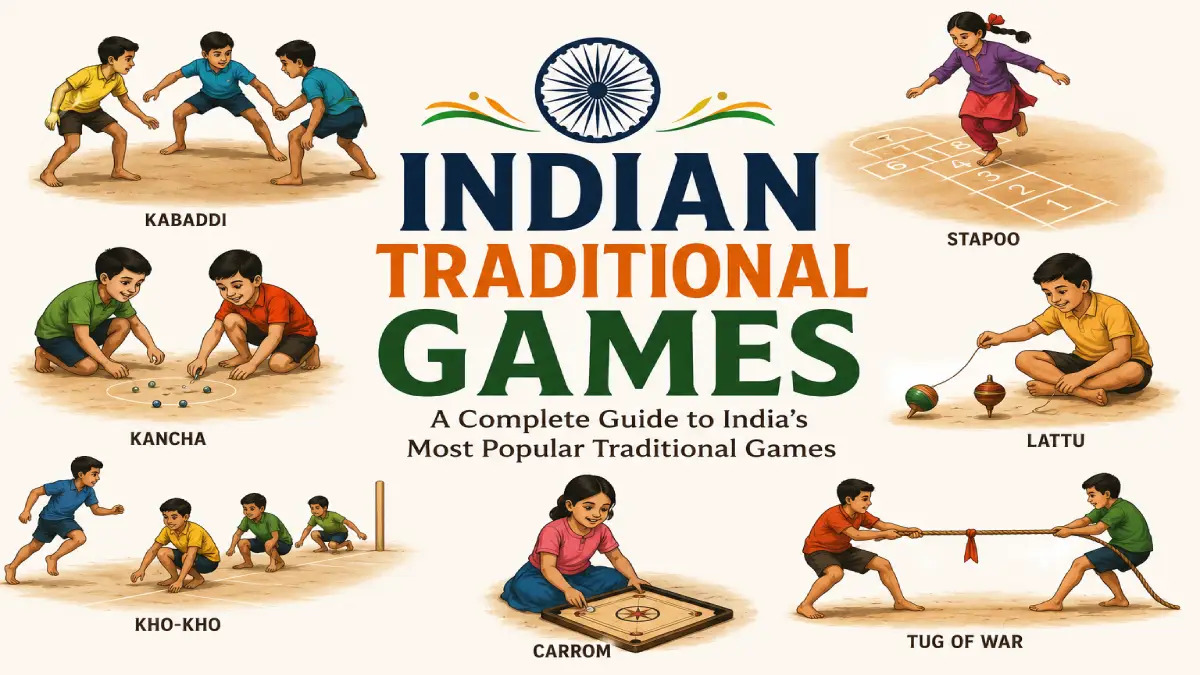
Long before high-end consoles, digital screens, and virtual reality transformed entertainment, the streets, courtyards, and open fields of India were vibrant arenas of play. Indian traditional games are not merely recreational activities; they are an integral part of India's rich cultural heritage. Designed with deep tactical, physical, and social intelligence, these games served as natural training grounds for strategic thinking, agility, spatial awareness, and community bonding. From simple games requiring just a few smooth stones or wooden sticks to intense physical disciplines requiring raw stamina, India's traditional play culture offers an incredible variety of experiences. In this complete guide, we explore the most popular traditional games across India, their origins, player requirements, and regional roots.
The Cultural Legacy of Indian Traditional Play
Traditional outdoor and indoor games in India have evolved over thousands of years. Many of these activities trace their lineage back to ancient texts like the Mahabharata and Ramayana, as well as ancient Gurukul traditions where play was integrated into physical education. Unlike modern video games, these traditional games require minimal equipment, making them accessible to everyone regardless of background. They foster conflict resolution, teamwork, and raw physical reflexes without needing structured supervision.
Popular Traditional Games of India
1. Gilli Danda
Gilli Danda is often considered the ancient street predecessor to modern cricket and baseball. Played with two simple pieces of wood-a long stick called a Danda and a smaller peg tapered at both ends called a Gilli-this game demands sharp hand-eye coordination and spatial judgment. The hitter balances the gilli over a shallow pit, taps its tapered edge with the danda to pop it into the air, and strikes it hard across the field. If fielders catch the flying gilli, the hitter is out; otherwise, the distance is measured in danda lengths to calculate points. It remains one of the most iconic rural street games across South Asia.
- Popular States: Uttar Pradesh, Punjab, Bihar, Maharashtra, Rajasthan, and Gujarat.
- Player Count: 2 to 10+ players.
- Environment: Outdoor.
- Read the complete guide: Learn the exact striking techniques, physics, and scoring rules of Gilli Danda in our detailed deep-dive.
2. Lagori / Seven Stones (Pittu Garam / Sitoliya)
Lagori, popularly known as Pittu Garam or Sitoliya across Northern and Western India, is a fast-paced team game combining accuracy, dodgeball dynamics, and rapid coordination. Seven flat stones are stacked on top of each other in the center of the field. A player from the attacking team throws a soft ball to knock down the stack. Once shattered, the attackers must rebuild the stack from largest to smallest while dodging the ball thrown by the defending team. If an attacker is tagged by the ball before rebuilding the stack, they are out.
- Popular States: Karnataka, Maharashtra, Rajasthan, Punjab, Delhi, and Andhra Pradesh.
- Player Count: 6 to 12 players (2 teams).
- Environment: Outdoor.
- Read the complete guide: Discover team strategies, positioning hacks, and dodge tactics for Lagori in our complete article.
3. Kho Kho
Kho Kho is one of India's most popular structured field tag games, requiring exceptional speed, stamina, and sudden directional turns. Played on a rectangular field with two posts at opposite ends, nine players from the defending team sit in a line along the central lane, alternate players facing opposite directions. Three chasers from the opposing team enter the court. The chasers attempt to tag the defenders, passing the chase off to a seated teammate by touching their back and shouting "Kho!". It is an officially recognized sport with national leagues today.
- Popular States: Maharashtra, Gujarat, West Bengal, Punjab, and South Indian states.
- Player Count: 12 players per team (9 on the court).
- Environment: Outdoor / Indoor Mat Courts.
- Read the complete guide: Explore the professional rules, court measurements, and footwork drills of Kho Kho in our step-by-step guide.
4. Kabaddi
Kabaddi is an ancient contact sport that tests endurance, tactical breathing, and muscular power. Two teams occupy opposite halves of a court. A designated "raider" crosses into the opponent's court, continuously chanting the word "Kabaddi" without breaking breath, and attempts to tag as many defenders as possible before returning to their own half. The defending team must work together to tackle and hold the raider inside their zone. Kabaddi has seen a massive global revival through professional leagues.
- Popular States: Punjab, Haryana, Tamil Nadu, Maharashtra, Andhra Pradesh, and Bihar.
- Player Count: 7 players per team on the court.
- Environment: Outdoor / Indoor Mats.
- Read the complete guide: Check out our complete breakdown of Kabaddi raiding techniques, defensive holds, and scoring systems.
5. Kancha (Marbles / Goti)
Kancha is a street game of precision aim played with small, colorful glass marbles. Players draw a circle on dry earth and place several target marbles inside it. Standing behind a shooting line, players take turns aiming at the marbles using a catapult-style flick of their thumb against their index finger. If a player successfully strikes a marble out of the circle without leaving their shooter marble inside, they win the marble. The game develops high levels of focus and spatial calculation.
- Popular States: Pan-India (Uttar Pradesh, Bihar, Rajasthan, West Bengal, Tamil Nadu).
- Player Count: 2 to 6 players.
- Environment: Outdoor.
- Read the complete guide: Master the thumb-flick technique and geometrical line calculations of Kancha in our dedicated guide.
6. Langdi
Langdi is a traditional Indian tag game that acts as a foundational exercise for agility and lower-body strength. One team defends while the other team sends a single attacker who must hop on one leg to tag out as many defenders as possible within a set time limit. If the hopper's raised foot touches the ground or if they step outside the court boundaries, they are disqualified. The teams then swap roles after each turn.
- Popular States: Maharashtra, Gujarat, Madhya Pradesh, and Goa.
- Player Count: 12 players per team.
- Environment: Outdoor.
- Read the complete guide: Read our in-depth post on how Langdi is used as an endurance training game in regional sports academies.
7. Stapoo / Kith-Kith / Hopscotch / Nondi
Known as Stapoo in the North, Kith-Kith in Bengal, and Nondi in Tamil Nadu, this grid-based jumping game is played mainly by children in neighborhood streets. A grid of numbered squares is drawn on the ground with chalk or charcoal. A player tosses a small marker or stone into Square 1, hops through the pattern on one or two legs while avoiding lines, retrieves the stone on the return journey, and hops back out. The pattern repeats up to higher numbered squares.
- Popular States: Pan-India (Delhi, Bengal, Tamil Nadu, Maharashtra, Punjab).
- Player Count: 1 to 5 players.
- Environment: Outdoor.
- Read the complete guide: Find out about different regional court layouts and variation rules for Stapoo across India.
8. Lattoo (Spinning Top)
Lattoo is a classic skill game centered on spinning wooden tops carved with horizontal grooves. Players tightly wind a thick cotton string around the top from its sharp iron tip to the crown. With a swift flick of the wrist and pull of the string, the top is hurled onto flat dirt, where it spins rapidly due to gyroscopic stability. Advanced players can scoop the spinning top onto their open palm without breaking its rotation, a trick called Aasmani.
- Popular States: Gujarat, Uttar Pradesh, Tamil Nadu, Andhra Pradesh, and Maharashtra.
- Player Count: 1 or more players.
- Environment: Outdoor.
- Read the complete guide: Learn how to wrap, launch, and perform palm tricks with the traditional Lattoo in our full post.
9. Rumal Chor
Rumal Chor (Handkerchief Thief) is a lively circle-based recreational game played widely in primary schools and playgrounds. All players sit in a large circle facing inward. One designated player walks around the outside of the circle carrying a handkerchief without letting anyone see where they drop it. They secretly drop the handkerchief behind one sitting player and continue running. If the sitting player notices the handkerchief, they must pick it up and chase the dropper before they take the vacant seat.
- Popular States: Punjab, Haryana, Uttar Pradesh, Delhi, and Rajasthan.
- Player Count: 8 to 20+ players.
- Environment: Outdoor / Indoor.
- Read the complete guide: Discover how Rumal Chor builds sensory awareness and quick reaction time in young children.
10. Chor Sipahi
Chor Sipahi (Thief and Police) is a role-playing tag game that turns neighborhood alleys into active chase zones. Players split into two groups: the Police (Sipahi) and the Thieves (Chor). The police team gives the thieves a short head start to hide or scatter across a designated play zone. The police then track down and tag all the thieves to lock them in a designated "jail". Once all thieves are caught, roles are reversed for the next round.
- Popular States: Pan-India.
- Player Count: 6 to 15+ players.
- Environment: Outdoor.
- Read the complete guide: Read our strategic guide on effective hiding, tracking, and jailbreak mechanics in Chor Sipahi.
11. Vish Amrit
Vish Amrit is the Indian regional variation of Freeze Tag. One player is designated as the tagger ("the catcher"). When the tagger touches any player and shouts "Vish" (Poison), that player must freeze instantly in their position. Frozen players can only be unfrozen and returned to play if an unfrozen teammate touches them and shouts "Amrit" (Elixir). The round ends when the tagger successfully freezes all active players on the field.
- Popular States: Delhi, Uttar Pradesh, Haryana, Maharashtra, and Bihar.
- Player Count: 4 to 15+ players.
- Environment: Outdoor.
- Read the complete guide: Uncover teamwork tactics and rescue strategies for Vish Amrit in our detailed feature.
12. Aankh Micholi (Blindfold Tag)
Aankh Micholi is an ancient sensory game played across all age groups. One player is blindfolded using a thick cloth or scarf and spun around a few times to gently disorient their sense of direction. The blindfolded player must navigate the play area using sound cues, footsteps, and laughter to catch and identify other players. The first person caught and correctly identified becomes the blindfolded tagger for the next round.
- Popular States: Pan-India.
- Player Count: 4 to 10+ players.
- Environment: Outdoor / Indoor.
- Read the complete guide: Learn about safety precautions and game variations for playing Aankh Micholi indoors and outdoors.
13. Posham Pa
Posham Pa is a singing and catching game played predominantly by young children. Two players form an arch with their hands joined high above their heads, acting as a gate. The remaining players walk in a single line passing under the arch while singing the traditional "Posham Pa" rhyme. As the song ends on the final line, the two gatekeepers drop their arms to catch whichever player is trapped inside the arch. The caught player then joins the gatekeeper team.
- Popular States: Delhi, Uttar Pradesh, Punjab, Rajasthan, and Madhya Pradesh.
- Player Count: 6 to 15 players.
- Environment: Outdoor / Indoor.
- Read the complete guide: Explore the cultural origins and complete lyrics of the Posham Pa song in our full article.
14. Chain Chain
Chain Chain is a dynamic outdoor tag game where the chasing team gets progressively larger and more formidable as players are caught. The game starts with a single tagger. When the tagger touches a runner, that runner must hold hands with the tagger to form a chain. As more players are tagged, they join the holding-hands chain. Only the players at the two extreme open ends of the chain can tag remaining free runners.
- Popular States: Pan-India (Gujarat, Maharashtra, West Bengal, Uttar Pradesh).
- Player Count: 6 to 20+ players.
- Environment: Outdoor.
- Read the complete guide: Read our guide on how to maneuver long player chains without breaking hand-grips in Chain Chain.
15. Patangbazi (Kite Flying)
Patangbazi is a traditional sport and festive passion, celebrated intensely during festivals like Makar Sankranti and Independence Day. Players fly lightweight paper and bamboo kites using specialized cotton line coated with ground glass (Manjha). The competitive essence lies in Penti (kite dueling), where fliers maneuver their kites in mid-air to entangle and cut the opponent's line using wind velocity and line tension control.
- Popular States: Gujarat, Rajasthan, Punjab, Uttar Pradesh, West Bengal, and Telangana.
- Player Count: 2 to 100+ (Dueling & Festival Competitions).
- Environment: Outdoor (Rooftops & Open Fields).
- Read the complete guide: Discover aerodynamics, line preparation, and duka/firi maneuvering techniques in our complete Kite Flying guide.
16. Mallakhamb
Mallakhamb is an extraordinary traditional Indian sport that combines aerial gymnastics, yoga postures, and wrestling grips on a vertical wooden pole or hanging rope. Originating as a conditioning exercise for ancient wrestlers, athletes perform complex aerial flips, locks, and balances on a polished teak or rosewood pole smeared with castor oil. It demands extreme core strength, flexibility, and physical courage.
- Popular States: Maharashtra, Madhya Pradesh, Tamil Nadu, and Gujarat.
- Player Count: Individual discipline.
- Environment: Outdoor / Gymnasiums.
- Read the complete guide: Explore the history, pole specifications, and athletic benefits of Mallakhamb in our specialized post.
17. Vallam Kali (Boat Racing)
Vallam Kali is the iconic traditional snake boat race of Kerala, held annually during the harvest festival of Onam. Paddled in long canoe-style boats known as Chundan Vallam (measuring over 100 feet in length), each boat holds over 100 rowers, rhythmically paddling to the beat of traditional boat songs (Vanchipattu). It is one of the largest team sports in the world, showcasing extraordinary synchronization and community spirit.
- Popular States: Kerala.
- Player Count: 100+ rowers per boat.
- Environment: Outdoor (Backwaters & Rivers).
- Read the complete guide: Experience the history of the Nehru Trophy Boat Race and row rhythm dynamics in our detailed feature.
18. Jallikattu
Jallikattu is a traditional bull-embracing event practiced during the harvest festival of Pongal in Tamil Nadu. An indigenous breed of bull (Kangayam) is released into an open arena through a narrow gate called the Vadivasal. Courageous participants attempt to hold onto the bull's prominent hump with both arms for a specific distance or duration to claim prizes tied to its horns. It is deeply rooted in rural agrarian culture and bull preservation.
- Popular States: Tamil Nadu.
- Player Count: Multiple individual participants.
- Environment: Outdoor Arena.
- Read the complete guide: Learn about the heritage, native bull breeds, and strict regulations surrounding Jallikattu today.
19. Tug of War (Rassa Kashi)
Rassa Kashi (Tug of War) is a pure strength and leverage contest played across villages and festival grounds in India. Two teams stand on opposite sides of a central line, holding a thick natural fiber rope. A flag is tied to the middle of the rope directly over the centerline. Upon signal, both teams pull backward using their combined body weight and leg drive. The team that pulls the center flag across their boundary line wins.
- Popular States: Pan-India (Punjab, Haryana, Kerala, Rajasthan, Himachal Pradesh).
- Player Count: 8 players per team.
- Environment: Outdoor.
- Read the complete guide: Master footing techniques, rope grip strategies, and pulling rhythms for Rassa Kashi in our article.
20. Pallanguzhi
Pallanguzhi is an ancient traditional mancala board game originating in South India. Played on a wooden or brass board containing two rows of fourteen pit cups, the game utilizes small cowrie shells, tamarind seeds, or smooth pebbles. Players pick up seeds from a cup and distribute them one by one into adjacent cups in a circular fashion. The goal is to capture maximum seeds through strategic counting and mathematical planning.
- Popular States: Tamil Nadu, Kerala, Karnataka, and Andhra Pradesh.
- Player Count: 2 players.
- Environment: Indoor.
- Read the complete guide: Master the mathematical distribution strategies and opening moves of Pallanguzhi in our complete guide.
21. Changa Po (Chaupar / Pachisi Variant)
Changa Po is a traditional board game variant closely linked to ancient games like Chaupar and Pachisi. Played on a cross-shaped cloth board, players roll cowrie shells or long wooden dice (Pashaka) to move their tokens from starting positions to the central home square. The game heavily relies on probability calculation, offensive blocking, and tactical maneuvers to capture opponent tokens along the track.
- Popular States: Rajasthan, Gujarat, Madhya Pradesh, and Punjab.
- Player Count: 2 to 4 players.
- Environment: Indoor.
- Read the complete guide: Discover the rules, board setup, and cowrie scoring values for Changa Po in our board games breakdown.
22. Atya Patya
Atya Patya is a traditional Indian line-defense tag game that tests agility, lateral movement, and tactical teamwork. The court consists of nine parallel trenches or lines drawn horizontally across a central court line. The defending team assigns players to defend each line, moving only laterally along their designated line. The attacking team must cross all nine lines from one end of the court to the other without being tagged.
- Popular States: Maharashtra, Karnataka, and Madhya Pradesh.
- Player Count: 9 players per team.
- Environment: Outdoor.
- Read the complete guide: Learn the court layout, trench defense tactics, and scoring systems of Atya Patya in our full post.
23. Lagam
Lagam is a traditional street target game that sharpens throwing accuracy and distance measurement using flat stones or discarded rubber tiles. Players mark a baseline and place a target stone at a specified distance. Each player throws their handheld stone attempting to hit or land closest to the target stone. Complex scoring systems apply depending on whether the stone strikes, nudges, or flips the target.
- Popular States: Rural regions of Maharashtra, Andhra Pradesh, and Karnataka.
- Player Count: 2 to 6 players.
- Environment: Outdoor.
- Read the complete guide: Read our guide on stone selection, wrist flicks, and scoring rules for Lagam.
24. Gutte (Five Stones)
Gutte is a classic skill game played sitting down, using five smooth pebbles or small polished stones. A player throws one stone up into the air, quickly picks up one or more stones from the ground using the same hand, and catches the falling stone before it hits the floor. The game progresses through several increasingly difficult levels, requiring players to pick up stones in pairs, triplets, or complex hand patterns.
- Popular States: Uttar Pradesh, Rajasthan, Punjab, Bihar, and Madhya Pradesh.
- Player Count: 1 to 4 players.
- Environment: Indoor / Outdoor.
- Read the complete guide: Learn all 7 progressive skill levels of Gutte in our detailed step-by-step tutorial.
25. Bamboo Stilt Walking (Gedi)
Gedi or Bamboo Stilt Walking is a traditional balance sport practiced primarily during monsoon seasons and rural fairs. Stilts are made from sturdy bamboo poles fitted with wooden foot pegs attached at a fixed height above the ground. Participants mount the stilts and walk, race, or navigate obstacle courses without falling off. It demands high core stability, balance control, and leg strength.
- Popular States: Chhattisgarh, Madhya Pradesh, Odisha, and Punjab.
- Player Count: Individual / Racing Groups.
- Environment: Outdoor.
- Read the complete guide: Discover how bamboo stilts are constructed and balanced safely in our specialized feature.
Comparison Table of India's Traditional Games
| Game Name | Primary Skill | Players Needed | Environment | Regional Names |
|---|---|---|---|---|
| Gilli Danda | Hand-Eye Coordination | 2–10+ | Outdoor | Vitti Dandu, Kitti Pul |
| Lagori | Team Dodging & Strategy | 6–12 | Outdoor | Pittu Garam, Sitoliya |
| Kho Kho | Sprinting & Reflexes | 12 per team | Outdoor/Indoor | Kho |
| Kabaddi | Breath Control & Power | 7 per team | Outdoor/Indoor | Chedugudu, Hu-Tu-Tu |
| Kancha | Precision Aiming | 2–6 | Outdoor | Goti, Goli, Bati |
| Lattoo | Wrist Balance | 1+ | Outdoor | Bambaram |
| Patangbazi | Aerodynamic Control | Dueling | Outdoor | Kite Dueling |
| Pallanguzhi | Strategic Counting | 2 | Indoor | Alagulimane |
Frequently Asked Questions (FAQs)
Are traditional Indian games helpful for child development?
Yes, traditional games provide complete physical, cognitive, and social development. They build hand-eye coordination, fine motor skills, cardiovascular endurance, and social problem-solving skills without relying on structured adult supervision or screen time.
Can these traditional games be played with modern equipment?
Absolutely. Games like Lagori can be played safely with foam blocks and a soft tennis ball. Kabaddi and Kho Kho are now played professionally on synthetic sports mats with proper protective gear.
Where can I buy authentic traditional Indian game sets like Pallanguzhi or Lattoo?
Authentic wooden spinning tops, cowrie shells, and carved wooden boards are available at traditional craft bazaars, local markets, and specialized online stores selling handmade Indian heritage toys.
Conclusion
Indian traditional games are timeless treasures that bridge generations, teaching valuable life skills through joyful physical play. Bringing these outdoor and indoor games back into our daily routines is one of the best ways to preserve our cultural heritage while staying active and connected with our communities.