 Eno
EnoTraditional American & Western Street Games: The Ultimate Guide to Classic Neighborhood Play
From Four Square and Kickball to Stickball, Capture the Flag, and Double Dutch - the ultimate guide to 25 classic American and Western street games, their rules, and the skills they build.
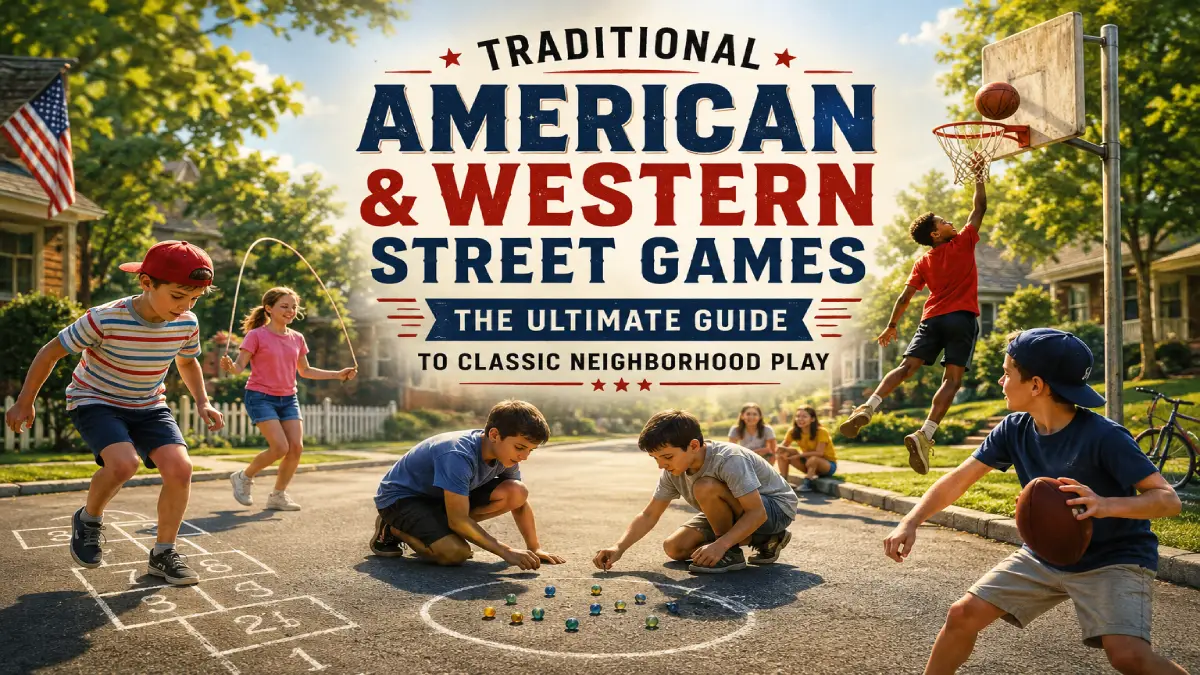
Long before smartphones, video game consoles, and modern streaming platforms dominated free time, the streets, parks, and suburban driveways of the United States and the Western world were alive with continuous play. Traditional American street games were an essential part of growing up. Designed with minimal equipment-often just a rubber ball, a piece of sidewalk chalk, or a wooden stick-these activities transformed ordinary pavement into thrilling fields of competition. Beyond mere recreation, classic Western games taught generations of children spatial reasoning, tactical communication, physical agility, and conflict resolution without adult supervision. In this comprehensive guide, we explore the history, mechanics, player requirements, and cultural significance of the most popular traditional games across the USA and Western countries.
The Heritage of Western Outdoor & Street Play
American neighborhood play culture flourished throughout the 20th century. Urban centers like New York City, Chicago, and Philadelphia gave rise to pavement-based games tailored for asphalt, fire hydrants, and brick walls. Meanwhile, suburban parks popularized wide-area team games. These traditional games created strong community bonds, encouraged high daily physical activity, and instilled a sense of sportsmanship that modern screen time struggles to replicate.
Top Traditional American & Western Games
1. Four Square
Four Square is a classic American elementary school and driveway game played on a square court divided into four smaller equal squares (numbered 1 to 4, or King, Queen, Jack, Ace). Players bounce a rubber playground ball between the squares. The goal is to eliminate the player in the highest square (King/Square 4) and advance up through the ranks.
- Popular Regions: United States, Canada, and Australia.
- Player Count: 4 active players (plus a line of waiting players).
- Environment: Outdoor (Pavement/Asphalt).
- Read the complete guide: Learn the official bounce rules, cherry-bomb mechanics, and court layout for Four Square in our detailed article.
2. Kickball
Kickball is an iconic American invention that combines the rules of baseball with the accessibility of a large rubber playground ball. Instead of pitching a baseball to a batter with a wooden bat, the pitcher rolls a large red ball toward home plate, and the kicker strikes it with their foot before running the bases.
- Popular Regions: Pan-USA, Canada.
- Player Count: 8 to 18+ players (2 teams).
- Environment: Outdoor (Grass fields or large blacktops).
- Read the complete guide: Explore field dimensions, outs, and team strategies for classic Kickball.
3. Red Rover
Red Rover is a high-energy traditional playground game that tests physical strength and momentum. Two long lines of players stand facing each other about 30 feet apart, holding hands tightly. One team calls out, "Red Rover, Red Rover, send [Player's Name] right over!" The chosen player runs full speed toward the opposing line and attempts to break through their joined hands.
- Popular Regions: United States, United Kingdom, and Canada.
- Player Count: 10 to 20+ players.
- Environment: Outdoor (Grassy fields recommended for safety).
- Read the complete guide: Read our guide on safety rules, line positioning, and gripping techniques for Red Rover.
4. Tetherball
Tetherball is a classic American park and schoolyard game consisting of a stationary metal pole with a rubber ball tied to the top via a long rope. Two players stand on opposite sides of the pole and strike the ball with their bare hands, trying to wind the rope entirely around the pole in their designated direction.
- Popular Regions: United States, Canada.
- Player Count: 2 players.
- Environment: Outdoor.
- Read the complete guide: Discover serving techniques, foul lines, and pole setup specs for Tetherball.
5. Duck, Duck, Goose
Duck, Duck, Goose is an ancient traditional sitting game played by young children in preschools, birthday parties, and backyards. All players sit in a circle facing inward while a designated "picker" walks around tapping each player's head, saying "Duck". Eventually, the picker taps a player and shouts "Goose!", triggering a high-speed chase around the circle back to the open seat.
- Popular Regions: USA, UK, Canada, Australia, and Western Europe.
- Player Count: 6 to 15+ players.
- Environment: Indoor or Outdoor.
- Read the complete guide: Explore regional variations like 'Duck, Duck, Gray Duck' in our full feature.
6. American Hopscotch
Hopscotch is a timeless sidewalk chalk game enjoyed across the Western world. A numbered grid (usually 1 through 10) is drawn on the pavement. A player tosses a small beanbag or flat stone into Square 1, hops through the grid on one or two feet while avoiding lines, picks up the marker on the return trip, and repeats the process for higher numbers.
- Popular Regions: Pan-USA and Western Europe.
- Player Count: 1 to 6 players.
- Environment: Outdoor (Sidewalks & Driveways).
- Read the complete guide: Master the classic layout and balance routines for Hopscotch in our step-by-step post.
7. Classic Marbles (Ringer)
Marbles has been a favorite street game in America for well over a century. In the traditional American variant called "Ringer," 13 target glass marbles are placed in the shape of a cross inside a 10-foot chalk circle. Players use a larger shooter marble ("aggie" or "shooter") to knock target marbles out of the ring using a thumb-flick motion.
- Popular Regions: United States, UK.
- Player Count: 2 to 6 players.
- Environment: Outdoor (Flat dirt or asphalt).
- Read the complete guide: Check out shooter gripping styles, marble types, and official tournament rules for Marbles.
8. Stickball
Originating on the crowded streets of New York City, Stickball is an urban adaptation of baseball. Played using a broom handle or light wooden stick and a pink rubber spalding ball ("spaldeen"), players use sewer grates, parked cars, or fire hydrants as base markers. The batter hits a bounced or pitched ball down narrow city streets.
- Popular Regions: Northeastern United States (New York, Philadelphia, Boston).
- Player Count: 4 to 10 players.
- Environment: Outdoor (City Streets & Alleyways).
- Read the complete guide: Uncover the history of NYC street stickball, pitching styles, and ground rules in our article.
9. Capture the Flag
Capture the Flag is the ultimate wide-area outdoor game played in backyards, forests, and summer camps. A large playing area is divided into two equal territories, each containing a hidden or guarded flag and a designated "jail". Players sneak into enemy territory to steal the flag and bring it back to their side without getting tagged and sent to jail.
- Popular Regions: United States, Canada, UK, and Western Europe.
- Player Count: 8 to 30+ players.
- Environment: Outdoor (Parks, Woods, Large Yards).
- Read the complete guide: Learn offensive raiding strategies, jailbreak tactics, and defense setups for Capture the Flag.
10. Cornhole (Bags / Bean Bag Toss)
Cornhole is a classic American lawn game that originated in the Midwest and has grown into a major national pastime. Players take turns pitching 16-ounce fabric bean bags at an inclined wooden board featuring a hole near the top. Scoring 3 points for a bag through the hole and 1 point for a bag resting on the board, it requires smooth arc precision.
- Popular Regions: United States.
- Player Count: 2 or 4 players (1v1 or 2v2).
- Environment: Outdoor (Lawns, Tailgates, Backyards).
- Read the complete guide: Master throwing techniques, bag slide physics, and official scorekeeping for Cornhole.
11. Red Light, Green Light
Red Light, Green Light is a fast-paced reaction game that sharpens listening skills and body control. One player acts as the "Traffic Light" standing far away with their back turned. When they shout "Green Light!", players run forward. When they turn around and shout "Red Light!", everyone must freeze instantly. Anyone caught moving is sent back to the starting line.
- Popular Regions: Pan-USA and Western Europe.
- Player Count: 4 to 15+ players.
- Environment: Outdoor / Indoor.
- Read the complete guide: Discover variants and stealth strategies for winning Red Light, Green Light.
12. Freeze Tag
Freeze Tag is the foundational American chasing game. One player is "It" (the tagger). When "It" tags another runner, that runner must freeze in place with their arms extended. Active runners can unfreeze frozen teammates by crawling between their legs or tagging their hand, keeping the game in dynamic motion until everyone is frozen.
- Popular Regions: Pan-Western World.
- Player Count: 4 to 15+ players.
- Environment: Outdoor.
- Read the complete guide: Read our guide on tagger strategies and rescue tactics in Freeze Tag.
13. Double Dutch (Jumping Rope)
Double Dutch is a high-skill street exercise and rhythm game developed in urban American communities. Two turners rotate two long jump ropes in opposite directions simultaneously, while one or two jumpers step inside to execute complex footwork, leaps, and rhythmic chants without tripping on the ropes.
- Popular Regions: Urban United States (New York, Chicago, Atlanta).
- Player Count: 3 or more players.
- Environment: Outdoor (Asphalt or concrete).
- Read the complete guide: Learn rope turning cadence, jumping footwork, and traditional Double Dutch rhymes.
14. Simon Says
Simon Says is a classic commands and listening game designed to test concentration. One leader plays "Simon" and gives physical commands to the group (e.g., "Touch your toes"). However, players must only perform the action if the command begins with the phrase "Simon says...". If a player executes an action without the prefix, they are eliminated.
- Popular Regions: United States, Canada, UK, Australia.
- Player Count: 3 to 15+ players.
- Environment: Indoor / Outdoor.
- Read the complete guide: Explore trick commands and leadership strategies in Simon Says.
15. Ground Chalk Shadow Tag
A creative variation of traditional tag played on sunny driveways and playgrounds. Instead of tagging a runner's physical body, "It" must step on the runner's shadow on the pavement. Runners use tree shadows, building shade, and rapid body shifts to hide their shadows from the tagger.
- Popular Regions: United States and Australia.
- Player Count: 3 to 10 players.
- Environment: Outdoor (Sunny Paved Areas).
- Read the complete guide: Discover positioning tricks and sunny day rules for Shadow Tag.
16. Wallball (Suicide / Butts Up)
Wallball is an intense urban pavement game played against a smooth, solid brick or concrete wall using a high-bouncing rubber ball. Players bounce the ball against the wall, and the next player must catch or strike it on its return bounce. Missing the ball or dropping a catch forces the player to sprint to touch the wall before someone throws the ball at the wall.
- Popular Regions: United States, Australia.
- Player Count: 3 to 10 players.
- Environment: Outdoor (School walls or brick alleyways).
- Read the complete guide: Learn throwing power techniques and safety etiquette for Wallball.
17. Horseshoes
Horseshoes is a traditional American target game played in yards and rural fairs. Players pitch heavy iron horseshoes across a lawn toward two vertical steel stakes driven into the ground 40 feet apart. Points are awarded for leaners, ringers (encircling the stake), or landing closest to the stake.
- Popular Regions: Rural and Suburban United States.
- Player Count: 2 or 4 players.
- Environment: Outdoor Lawn / Sand Pit.
- Read the complete guide: Master pitching rotations, grip styles, and stake distances in Horseshoes.
18. SPD (Spud)
Spud is an energetic ball-throwing and guessing game. Every player is assigned a number. One player throws a rubber playground ball high into the air while shouting a number. The player whose number is called must catch the ball and shout "SPUD!", forcing all other scattering players to freeze. The thrower then takes three steps toward a frozen player and tries to hit them with the ball.
- Popular Regions: United States, Canada.
- Player Count: 5 to 12 players.
- Environment: Outdoor.
- Read the complete guide: Read our guide on throwing angles and dodging tactics in Spud.
19. Marco Polo
Marco Polo is a famous blindfolded swimming pool tag game played across North America. The tagger ("Marco") closes their eyes and calls out "Marco!", while all other swimming players must respond by shouting "Polo!". Using sound direction, the tagger navigates the pool to tag other swimmers.
- Popular Regions: United States, Canada, Western Europe.
- Player Count: 3 to 10 players.
- Environment: Outdoor Swimming Pool.
- Read the complete guide: Learn pool safety rules and sound localization techniques for Marco Polo.
20. Jacks (Knucklebones)
Jacks is an ancient hand-eye precision game played sitting on a flat surface. A player tosses a small rubber bouncy ball into the air, scoops up a specific number of metallic six-pointed "jacks" from the ground with one hand, and catches the ball before it bounces twice. The game progresses from "onesies" (picking up 1 jack at a time) to "tensies".
- Popular Regions: United States, UK, Canada.
- Player Count: 1 to 4 players.
- Environment: Indoor / Outdoor.
- Read the complete guide: Master hand scoops, ball bounces, and classic levels of Jacks in our tutorial.
21. Lawn Darts (Jarts)
Lawn Darts was a prominent suburban backyard game in the 1960s and 70s. Players tossed heavy weighted darts with plastic fins toward plastic target rings placed on a grassy lawn. Modern versions feature blunt, weighted safety bases to provide competitive fun without hazard.
- Popular Regions: United States.
- Player Count: 2 or 4 players.
- Environment: Outdoor Lawn.
- Read the complete guide: Explore the history, safety redesigns, and scoring of Lawn Darts.
22. Kick the Can
Kick the Can is a classic neighborhood evening game combining Hide and Seek, Tag, and Capture the Flag. A metal can is placed in the center of the play area. "It" closes their eyes and counts while players hide. When "It" tags a hidden player, they are sent to jail. However, any free player can sprint into the open area and kick the can to set all jailed players free.
- Popular Regions: Suburban United States and Canada.
- Player Count: 5 to 15+ players.
- Environment: Outdoor (Backyards & Streets).
- Read the complete guide: Master stealth approaches, jailbreaking, and distraction tactics in Kick the Can.
23. Blind Man's Buff
Blind Man's Buff is an ancient European and traditional American parlor and lawn game. One player is blindfolded and spun around several times. The blindfolded player must navigate the area using touch and auditory cues to tag and correctly identify other participants.
- Popular Regions: USA, UK, France, Germany.
- Player Count: 4 to 10 players.
- Environment: Indoor / Outdoor Lawn.
- Read the complete guide: Discover safety setup and historical roots of Blind Man's Buff.
24. Four Corners
Four Corners is a quiet room and indoor playground game favored in primary schools. Four corners of a room are labeled 1, 2, 3, and 4. One player stands in the middle with their eyes closed and counts to ten while all other players quietly choose a corner. The middle player calls out a corner number, and anyone standing in that designated corner is eliminated.
- Popular Regions: Pan-USA, Canada, Australia.
- Player Count: 5 to 20+ players.
- Environment: Indoor.
- Read the complete guide: Learn psychological guessing strategies and rules for Four Corners.
25. Ghost in the Graveyard
Ghost in the Graveyard is a favorite outdoor night game played in summer backyards. One player hides in the dark as the "Ghost" while others stay at home base counting. Players then search the dark yard. When someone spots the Ghost, they shout "Ghost in the graveyard!", and everyone sprints back to home base before the Ghost tags them.
- Popular Regions: United States and Canada.
- Player Count: 4 to 15 players.
- Environment: Outdoor (At Night).
- Read the complete guide: Read our guide on night safety, hiding tactics, and team communication in Ghost in the Graveyard.
Comparison Table of Western Street Games
| Game Name | Primary Skill | Players Needed | Environment | Primary Equipment |
|---|---|---|---|---|
| Four Square | Reaction & Precision | 4+ | Outdoor Asphalt | Playground Rubber Ball |
| Kickball | Kicking & Running | 8–18+ | Outdoor Field | Playground Ball & Bases |
| Capture the Flag | Stealth & Sprinting | 8–30+ | Outdoor Park | 2 Flags / Bandanas |
| Cornhole | Arc Pitching | 2–4 | Outdoor Lawn | 2 Boards & 8 Bean Bags |
| Tetherball | Hand Strikes | 2 | Outdoor | Pole, Rope & Ball |
| Stickball | Batting Accuracy | 4–10 | City Street | Broomstick & Rubber Ball |
| Double Dutch | Rhythm & Jump Timing | 3+ | Outdoor Pavement | 2 Long Jump Ropes |
Frequently Asked Questions (FAQs)
Why are traditional street games important for child development?
Traditional street games encourage independent decision-making, natural physical fitness, spatial awareness, and social negotiation without needing adult referees or electronic devices.
What is the most iconic urban American street game?
Stickball and Four Square are widely regarded as the most iconic American street games due to their minimal equipment needs and adaptation to concrete surfaces.
Are these games safe for modern kids to play in neighborhoods?
Yes, provided kids play in designated parks, driveways, or quiet residential cul-de-sacs with soft balls and supervision when playing near traffic.
Conclusion
Traditional Western and American street games represent a timeless culture of active, imaginative outdoor play. By introducing these classic games back into parks, schools, and neighborhood driveways, we can help children build lasting physical habits, social bonds, and unforgettable childhood memories.